%20(1)%20(1).svg "finovifi-white-logo 1 (1) (1) (1)")
Dark Web Check Fraud: How Banks Can Detect Risk Earlier
Read Time 4 mins | Written by: Karly Field
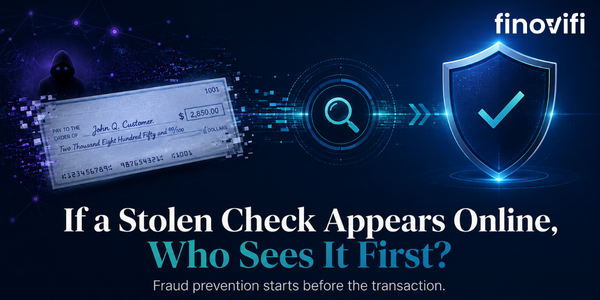
Why the next phase of fraud prevention starts before the transaction, but cannot end there.
For years, financial institutions have built fraud strategies around the moment suspicious activity enters the transaction stream. A check is presented, a card is used, or an unusual transaction appears, and then fraud tools go to work. Increasingly, however, the fraud event begins much earlier.
Stolen checks, compromised card information and other financial data can circulate through dark-web marketplaces and underground channels before a fraud attempt ever reaches the financial institution. That creates an important opportunity for banks and credit unions to identify exposure earlier, while there may still be time to investigate, prepare and act.
The fraud-prevention timeline is moving upstream.
The transaction should not be the first warning
Consider a stolen check. Before an altered or counterfeit version ever appears in a bank’s processing environment, information from the original check may already have been compromised, shared or offered for sale. If the financial institution can identify that exposure earlier, the fraud team has more options than it would if the first indication of a problem is the fraudulent item itself.
An earlier warning may allow the institution to review the affected account for additional risk, contact the customer, increase scrutiny on future items, investigate related activity or prepare frontline and operations teams for a potential fraud attempt. In other words, earlier intelligence can shift the institution from simply detecting fraud to building an early-warning approach around it.
But identifying exposure is only the first step.
Finding the exposure is only step one
Knowing that a check or card has been compromised provides an important signal, but the next question is what happens when the actual transaction arrives.
Fraudsters rarely rely on a single tactic. They alter checks, change amounts and payees, create counterfeit items, test multiple variations against the same account and move between institutions and channels. Because of that, financial institutions need multiple layers of intelligence operating at different points in the fraud lifecycle.
At Finovifi, we think about that lifecycle in three connected stages: see the exposure, evaluate the transaction and act while there are still options.
See the exposure earlier
FraudXchange gives financial institutions greater visibility into compromised check activity identified through dark-web monitoring and other fraud intelligence sources. Instead of waiting for a suspicious item to appear, fraud teams can gain insight into compromised checks connected to their institution and customers before an attempted transaction becomes the first sign of trouble.
CardGuard, included with FraudXchange, extends that approach to debit and credit cards. By monitoring for compromised card information associated with an institution’s BINs, CardGuard helps fraud teams identify potential card exposure earlier and investigate risk before it develops into a larger event.
The objective is simple: give the institution a signal before the fraud attempt becomes the first signal.
Evaluate the transaction when it arrives
Early intelligence is one layer of fraud prevention. Transaction-level fraud detection is another.
FraudSentry combines digital image forensics with transactional analysis to examine checks as they move through the institution’s processing environment. The platform is designed to help identify issues such as altered checks, counterfeit items, signature anomalies, check-stock discrepancies and unusual transaction patterns.
That distinction matters because fraud is rarely one-dimensional. A compromised check may be identified before an attempted fraud event, but institutions still need the ability to evaluate the item itself when it enters processing. By combining early intelligence with transaction and image analysis, fraud teams gain a more complete view of the risk.
Give fraud teams more opportunities to act
The objective of fraud technology should not simply be to generate another alert. It should be to create more opportunities for the institution to intervene before fraud becomes loss.
Dark-web intelligence can provide an earlier indication that something has been compromised. Transaction and image analysis can help identify suspicious activity when the item enters processing. Frontline and operational intelligence can then help the institution make better decisions at the point where action is still possible.
Each layer addresses a different moment in the fraud lifecycle, and together those layers create something especially valuable for fraud teams: more time. More time to investigate, more time to contact the customer, more time to apply additional scrutiny and more time to stop suspicious activity before funds move.
Fraud prevention is becoming a timeline, not a tool
Fraud strategies have traditionally been organized around individual technologies: check fraud detection, card monitoring, transaction monitoring, dark-web intelligence and other specialized tools. Fraudsters, however, do not operate within those product categories. They use whatever information, channel and weakness gives them an opportunity.
Financial institutions need a fraud strategy that reflects that same reality. The better question is no longer simply, “Can we detect the fraudulent transaction?” It is, “How early can we identify the risk, and how many opportunities do we have to stop it?”
For community financial institutions, that distinction is particularly important. Large institutions may have extensive fraud teams and multiple specialized systems, while community banks and credit unions often need technology that helps smaller teams focus their attention where it matters most without adding unnecessary operational complexity.
That is where a layered approach becomes especially valuable.
See fraud earlier. Stop it sooner.
Fraud prevention does not begin when a suspicious transaction appears, and it does not end when an exposure is discovered. The strongest defense connects intelligence across the fraud lifecycle, from the period before the transaction to the moment the transaction arrives and, ultimately, to the point where the institution still has an opportunity to act.
That is how fraud prevention moves from reacting to losses to getting ahead of them.
Want to learn how FraudXchange, CardGuard and FraudSentry can help your institution identify fraud risk earlier? Talk with Finovifi about building a more proactive fraud-prevention strategy.